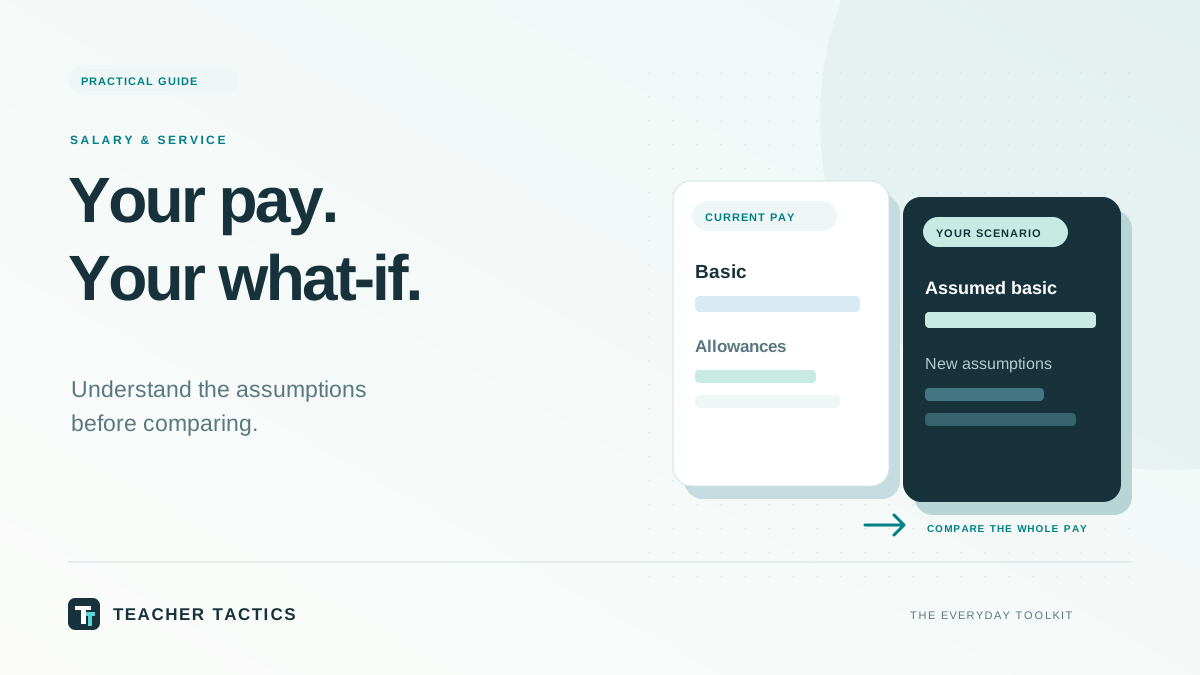
A fitment factor is an easy number to discuss and an incomplete way to judge a salary revision. Multiplying basic pay can produce a striking increase while the amount available each month changes much less. A useful estimate must show the current payslip, the proposed basic, the treatment of allowances and the employee deductions together. This guide builds that comparison with an ordinary matrix example and shows how to challenge its assumptions.
First establish what has actually been notified
The official 8th Central Pay Commission website publishes its terms of reference dated 3 November 2025. The Cabinet announcement describes the Commission’s work and the period allowed for recommendations. These documents establish a process; they are not a final revised salary matrix. In the official material reviewed for this guide on 27 October 2026, we did not find a final notified fitment factor and pay matrix to implement.
An effective date mentioned in an announcement also does not, by itself, establish when an individual employee will receive money. Implementation, eligibility, adoption by a particular employer and arrears instructions need their own orders. This matters especially when a central recommendation is discussed by employees of a state administration, a Union Territory, a university or an autonomous institution.
Build a current-pay baseline you can explain
Start with the month being compared and the employment system that governs the post. Use the current basic from the pay-fixation record or the correct matrix cell. Former grade pay is already incorporated into revised matrix basic; adding it again creates an inflated baseline. Then list DA, HRA, transport and other allowances separately. Keep employer pension contributions outside take-home pay and include employee contributions only once.
- Record the DA order and its effective date, rather than assuming a rate applies to every month.
- Check HRA eligibility and the posting category; an employee in government accommodation may not receive the same HRA.
- Check whether the transport amount already includes DA on transport.
- Enter tax, insurance, recoveries and fixed deductions from the relevant month if the comparison is meant to approximate money credited.
A complete example: J&K Level 5 at entry basic
The following is a generic arithmetic example, not a personal payslip or a promise of entitlement. Assume J&K Level 5 entry basic of ₹29,200, DA of 60%, Z-category HRA of 10%, standard transport base of ₹1,800 with DA, and an employee contribution of 10% of basic plus DA. Assume no medical allowance, income tax or other deductions for this example.
| Component | Current monthly amount |
|---|---|
| Basic pay | ₹29,200 |
| DA: 60% of basic | ₹17,520 |
| HRA: 10% of basic | ₹2,920 |
| Transport base plus DA | ₹2,880 |
| Gross salary | ₹52,520 |
| Employee contribution | ₹4,672 |
| After the listed deduction | ₹47,848 |
The last figure is deliberately described as after the listed deduction. If tax or another recovery applies, the actual bank credit will be lower. A comparison that omits these deductions can still be useful, but both sides must use the same scope. Do not compare current bank credit with a future gross figure.
Now change the assumptions, one at a time
For an illustrative factor of 2, revised basic is ₹58,400. Suppose the model starts new DA at 0%, keeps HRA at 10%, retains the current transport base without current DA, and recalculates the employee contribution at 10% of revised basic plus assumed new DA. Other fixed amounts remain zero in this example. These are modelling choices, not predicted 8th CPC allowance rules.
| Component | Illustrative monthly amount |
|---|---|
| Scenario basic | ₹58,400 |
| Assumed new DA: 0% | ₹0 |
| Assumed HRA: 10% | ₹5,840 |
| Retained transport base | ₹1,800 |
| Scenario gross | ₹66,040 |
| Recalculated employee contribution | ₹5,840 |
| After the listed deduction | ₹60,200 |
Basic has doubled, but the increase after the listed deduction is ₹12,352 a month: ₹60,200 minus ₹47,848. Multiplying that difference by 12 gives ₹1,48,224 for twelve identical months. It is not an arrears calculation, a tax-year forecast or an amount the government has approved.
Compare a range without pretending to predict it
| Illustrative factor | Scenario basic, nearest ₹100 | After listed deduction | Monthly difference |
|---|---|---|---|
| 1.80 | ₹52,600 | ₹54,400 | +₹6,552 |
| 2.00 | ₹58,400 | ₹60,200 | +₹12,352 |
| 2.50 | ₹73,000 | ₹74,800 | +₹26,952 |
Every row uses the same assumptions as the preceding example. Changing the HRA percentage, introducing tax, using an actual fixed pension deduction or retaining a different allowance will change the answer. The nearest-₹100 choice only makes this illustration tidy. A future official matrix could place pay differently, so ordinary rounding must never be described as official cell placement.
Five mistakes that make a projection misleading
- Carrying current DA into the revised salary without saying so. A revised-pay model needs an explicit treatment of DA.
- Multiplying total gross pay by the factor. The factor in this illustration acts on basic only.
- Adding former grade pay to matrix basic a second time.
- Treating employer contributions as spendable monthly income.
- Calling an annual difference arrears without calculating eligible months, changing basic, amounts already paid and applicable orders.
Also watch fixed-amount overrides. If you enter an actual DA amount, the calculator can show its equivalent percentage, but that does not turn the amount into an official rate. A fixed employee deduction carried into a future scenario is a different assumption from a contribution recalculated on the new basic. Keep the selected method visible when comparing results.
Questions worth answering before saving the result
Does the preset apply to my employer and month? Did I use a listed cell or an intentionally entered custom basic? Are special allowances and recovery amounts included consistently? What happens if new HRA is five percentage points lower? Does a smaller factor still improve the amount after deductions? A useful scenario tool makes these questions quick to explore instead of hiding them behind one impressive number.
What this estimate cannot settle
The comparison cannot establish a future pay level, increment date, promotion option, eligibility for an allowance, pension benefit, implementation schedule or arrears entitlement. Those questions require the applicable notified rules and individual service records. Use the estimate to understand the moving parts and to prepare better questions for the payroll office; use the eventual applicable order for an entitlement decision.
Sources & further reading
- 8th Central Pay Commission: terms of reference ↗
- PIB: Cabinet approval of terms of reference ↗
- Central civil revised pay rules, official mirror ↗
- J&K pay rules and matrix: SRO 193 ↗
- J&K DA order, effective 1 January 2026 ↗
Reviewed 27 Oct 2026. Sources were checked for this article. Policies and developing stories may change after this date.